Blue-Violet Iris Interior

Showing posts with label autumn. Show all posts

Thursday, April 14, 2016

The Final Four (Months of 2015)

I've been writing about 2015 in four-month chunks, so it's time to finish things off with a recap of September through December.

SEPTEMBER


I started off September by spending afternoons with Curly, the labradoodle puppy. His people were going to be gone all day, so I'd come around to feed him breakfast and play with him and take him out so that he wouldn't get too restless in his crate. He was going through his second naughty puppy phase (ages 7-9 months), so he was constantly, actively looking for trouble, especially the sort of trouble you could chew on! You couldn't take your eyes off of him for more than a moment! It was a considerable contrast to Mr. Gorgeous, who was then down to his final weeks of life. I went to visit him one afternoon in the middle of the month just to make sure I got to see him before he died and got to talk to his family about his impending passing. That was the same day that a woman backed into the side of my car in a parking lot, a simple low-speed fender bender that morphed into a nightmare when, after the fact, the person who hit my car accused me of hitting her! Despite being blatantly untrue (as the damage to our respective cars attested), it upset me to be accused of lying. If I had been to blame, I would have readily owned up to it. It was quite the learning experience. A few days later, I heard that Sandy passed away.

Curly the puppy, bouncy and lively and wanting to chew on everything!

Mr. Gorgeous.
You can see the blood on his hind foot from where he scraped open one of his nails while scuffing his paws because of his degenerative myelopathy. 

Goldie parted company with this life in mid-September.
You can read my tribute to her here.

Warm, sunny weather meant our garden continued to grow like crazy! Despite our vigilance, the occasional zucchini got away from us and grew into a monster. Here's a big one next to Abbey for comparison!

I took some nice photos of bees in September, like this tiny one about the size of a grain of rice...

...and these honey bees at Mr. Gorgeous' house, as well as...

....insects that mimic bees, such as this drone fly.

I observed a bald eagle observing me.

A nice photo of Abbey, who learned a number of hand signals that month.

And in the final days of September, I looked after Mr. Gorgeous for one last time and said goodbye.

He was gorgeous to the last.

One of the nights that I was there was when the full moon eclipse took place. This is what I wrote to my friends on that day:


I would have had a pretty great view of at least part of the eclipse if I'd made the effort, but I was putting that effort into Mr. Gorgeous And by "effort," I mean, "sitting on the couch in the TV room for a couple of hours and not going anywhere so he doesn't feel like he needs to get up and also to keep an eye on him to hopefully prevent him from having an accident in the house." Thanks to my efforts, Mr. Gorgeous got to spend three hours sleeping inside near me WITHOUT having an accident and now he's gone to bed. It may be years, but there will be another full moon eclipse. There will not be another Mr. Gorgeous.
My last photo of the one and only. You can read my tribute to him here.

And so both a month...

....and an era came to an end.

OCTOBER


A variety of dog-related happenings went on in October, including time with Curly (ending 10/4), Mr. Gorgeous' death (10/6), Abbey's 11th adopt-a-versary (10/12), a short overnight stay with Pipsqueak (10/13-10/15), and Abbey's first and last experience trying on fairy wings (10/30). I also marked my 6th anniversary of living with chronic migraines (10/19) and made an especially cute veggie witch for Halloween (10/31), but October of 2015 was the Month of the Filling.

Curly was still busy chewing!

I took Curly to play with Cutie! They had a blast together and I was so proud of how Cutie modified the intensity of her play to match Curly's size.

Abbey's 11th Gotcha Day portrait.

Pipsqueak!

While Abbey may like wearing shirts, she does NOT like wearing wings.

Every year, we put out a veggie witch for Halloween. It's been my job for some time now to do the decorating and this was one of my cuter efforts!

It had been a year and a half since I'd last been to the dentist because between the migraines and the allodynia and fatigue and bad weather and dog-sitting, I'd had to cancel and delay appointment after appointment. To my chagrin, my teeth had suffered during that time and I needed six fillings. It's been an ongoing source of discouragement that my health issues have been so hard on my teeth, but I'm lucking to have a very understanding dentist. An example:


Last night, my brain thought it would be amusing to torture me with both can't-fall-asleep AND can't-stay asleep insomnia. The result is that today I am exhausted and nauseated and my skin is burning and I am in no shape whatsoever to get three fillings this afternoon. So I called my dentist's office two hours before my appointment and said, "Hi, I have an appointment this afternoon but I'm not feeling well..." and the receptionist said, "Oh, is this Colleen?" You see, they know me there. They know I often have to cancel appointments with just a few hours' notice and they are not only accepting of this, but really care about my well-being and always treat me with understanding and compassion. Everyone at the dentist's office--from the receptionists to my hygienist to the dentist--know that I am doing the best I can. This means so much to me!


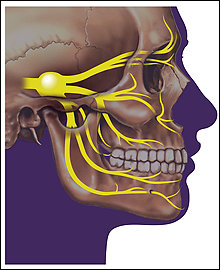
Trigeminal nerve branches.
I had three cavities on each side of my mouth, so we decided to do the three on the right first and the the three on the left one week later. This seemed like a decent plan, but it turned out to be overly ambitious. Dental work and migraines do not get along in general, and while fillings are not usually a big deal, the lower branches of my trigeminal nerve (the upper branch is in a perpetual state of inflammation, thanks to my migraines) got irritated and hypersensitive. I couldn't tolerate heat or cold (and not just food--going outside when the air was cool was a problem!) and chewing anything firmer than a soft piece of bread was painful. Worse yet, the weather started impacting the sites! Any of these irritating factors could trigger a deep, sharp ache, usually deep down in my jaw but sometimes encompassing much of my face, that lasted for hours. I went back to the dentist multiple times to get my bite adjusted and to discuss this pain, but there was not much to do except to wait to see if the nerves would calm down. They did, eventually, after two months, but during the first four weeks or so in particular, I was miserable and had to spend most of my time in bed because the pain was eating up all of my energy.

NOVEMBER


Thanks to the filling-induced nerve pain, November didn't start off very pleasantly. There was a bright spot, though. One day, while getting out of my car as he was passing by on a walk, Curly recognized me! And not only did he recognize me, he went bananas with excitement! I liked that he knew it was me even though I was completely out of context and it was very affirming to have him be so happy to see me, especially when I hadn't been feeling well. In other health news, I restarted physical therapy on my neck at long last and received an official fibromyalgia diagnosis. This wasn't a big shocker, just a confirmation of something I'd suspected for a while after it dawned on me that most people don't get weird aching and stiffness and pain that come sand goes without any actual injury. It has been a background issue for years, ever since it was triggered by tapering off a medication a decade ago. It was constant and agonizing back then, but fortunately, it's typically only a minor irritation now, though sometimes it makes it hard for me to sleep and when I don't sleep well, all of my health suffers. In other notes, I finally had my car examined by the insurance company after more than a month of arguing with the person who'd hit my car and their insurance immediately decided that they would accept my claim (and my insurance denied theirs) because the physical evidence backed up my story that I was not at fault. It was a relief to finally have that contentious issue resolved.

Abbey enjoys some late-fall sunshine.

Sable and Goldie were best friends.
I spent the third week of November in the company of Sable and friends. Sable, a border collie-black lab mix, was Goldie's best friend and next-door neighbor. She also lives with a Yorkie mix I'll call Scruffy and a calico cat, Beanie. Their owner used to be a set designer, so their house is incredibly cool, full of art and plants and whimsical details. The dogs are very friendly and a lot of fun, so despite my dental work still giving me pain, I enjoyed my time with them. I spent most of my hours there reading and snuggling with the dogs on the couch. I couldn't ask for a more pleasant way of passing the hours!

Sable and Scruffy.

Sable likes to demonstrate her affection by mashing her face against yours.

One of her many endearing traits is that she likes to sprawl upside-down on your lap.

We all spent a lot of time on the couch!

This ceramic dog's head knob on the cupboard containing the dog food is one of the house's many delightful details.

Sable can be a whirlwind of motion one minute...

...and sound asleep the next.

She and Scruffy are good friends who enjoy a bit of wrestling from time to time.

Scruffy is sweet, quiet, and rather timid. He needs a fair amount of reassurance from the people around him, but he's a formidable hunter when it comes to small animals.

Beanie regarded me with a great deal of suspicion. I do not believe I was able to pet her on this first stay.

After a quiet Thanksgiving with only my parents, I settled in for a long stay with Pipsqueak. There was only one major issue to mar this beginning: Abbey, in my absence, got up in the middle of the night, got into the trash, and had a severe case of wandering intestinal remorse all over the downstairs of our house. Prior to her experience with prednisone in February, Abbey had never once gotten into the trash, but she found it a fitting way to express her displeasure at my absence. Oh, Abbey!

Silly Miss Abbey.

The final days of November were notable for the freezing fog that created beautiful frost on every surface. We don't often have stretches of weather below freezing, so it was a cool opportunity to get some unusual photographs.


DECEMBER


Because Pipsqueak's family had never left her before and she's a sensitive little dog, we'd spent the better part of a year working up to the point where she was totally comfortable with me being there and her family being gone. All that hard work paid off: Pipsqueak adjusted to living with me without any apparent distress. She ate her meals without issue and took to sleeping under the covers with me. Pipsqueak's house is very calm and quiet, so it was a good place for continuing to recover from my fillings, though I missed seeing Abbey on a daily basis and she most certainly missed me. According to my parents, Abbey panted and paced and cried and barked and was constantly demanding to go outside and was not her usual mellow self at all. One day, my mother came home but couldn't find Abbey, but she could hear Abbey banging on something. She finally found Abbey in my closet. Abbey had managed to somehow squeeze in through a small opening, but then knocked the sliding doors off the track so she couldn't get back out again! She was very glad when I came home after two weeks away.

She may be tiny, but she's also mighty!

All snuggled up.

Pipsqueak and I spent most of our days in front of the fire.

Miss Abbey, happy now that I was home again.

December was notable for the record-breaking rain. It wasn't the usual Seattle drizzle, either. It poured and poured and poured, hour after hour. Pipsqueak was not a fan and refused to go out and I didn't blame her! Many of these rainstorms were accompanied by very low barometric pressure, which made me miserable. As a result, even when my facial nerves started to calm down around the third week of December, I continued to feel unwell. Also, I managed to really hurt my back while mailing out this year's c.creativity calendars. Not, as you might think, from packing or lifting, but by stumbling into a hole in the dark when walking out of the post office! I had a very hard time sitting and rising for several days and had to enlist help to move all of my things back home from Pipsqueak's.

It was my most successful year for calendars ever!

One bright spot was the fact for the first time in years, I was not dog-sitting for Christmas. This meant that I had more energy than usual and was better to enjoy the festivities. Also, I got jeggings. This may seem like a funny thing to be excited about, but I have had a terrible time wearing denim in recent years because the texture of the fabric triggers sensory overload for me. Therefore, dressing like a normal person (and not one in pajamas covered in dog hair) is usually stressful and exhausting. However, these jeggings are soft and stretchy enough that I can wear them without being overstimulated and are loose and stylish enough that I look like I'm wearing ordinary jeans.

Abbey posing (unhappily) by the Christmas tree.

Abbey gave me one more bit of trouble in December: I'd vowed, after our traumatic experience back in July (which I still haven't written about!) where she didn't recover properly from being sedaed, that I would not have her anesthetized unless absolutely necessary. I'd hoped it would be a long time before any such need should arise, but Abbey, being an old dog, decided to manufacture a new growth. A funny pinkish patch on her belly, it quadrupled in size within a matter of weeks. The vet didn't care for the feel of it, so off it came on the 30th, along with the large lipoma directly underneath it, just in case some cells had strayed from one to the other. It was a good thing we removed it, because it was a Level One mast cell tumor (but because it was removed completely, it shouldn't come back), and thankfully she suffered no ill effects whatsoever from the surgery. She was ready to walk herself out of the clinic and jump into the car under her own power to go home and didn't even seem to notice that she'd had surgery. As usual, I didn't need to put a cone on her because she left the stitches alone, though she did enjoy wearing the shirts I used to keep the stitches covered. The vet could tell that she hadn't licked them even once! I was proud of my girl! I was also very pleased that Abbey, now fully deaf, happily slept through the New Year's Eve fireworks without a single shake, pant, or whimper.

From surgery to sunbathing in a matter of hours!

That brings us to the end of 2015 and my attempt to write about it in four-month chunks, a practice I think I will have to abandon in 2016, seeing as it is already April and I have more interesting things to write about than just about what I've been doing. If you missed the earlier installments on 2015, you can find them here:


Even if I'm not able to write as much as I like, I do regularly share photos on my Facebook photography page.

Tuesday, December 9, 2014

33 Birds: November Edition

House finches and a song sparrow gather in a thicket.

My canine ornithological assistant.
Back in May, I published a blogpost called "33 Birds" that detailed the thirty-three different bird species I saw during three weeks of dog-sitting Mr. Gorgeous in the month of April. I spent two weeks in November looking after Goldie at her new house and on the second-to-last day of taking care of her, having photographed twelve bird species in the space of a single hour, I decided to tally my species total for the whole stay. When the numbers came in, I realized I ought to do another blogpost. As is true of the previous post, since I am aiming for quantity over quality, not all of these photos are great photos, and since I decided so late in the stay that I wanted to get pictures of every bird I'd seen, I didn't have sufficient time to get decent shots of every species. With that apology aside, let's talk about birds!

The property as seen from the dock.
The reason that I was able to get as many photographs of birds here at Goldie's as I did at Mr. Gorgeous' place has to do with the fact that the properties have striking similarities. Both are long, narrow pieces of land that have a mix of open, grassy spaces and margins with plenty of cover. Most crucially, both are located on a lake, with Goldie's property situated about 2.5 miles farther north. Although still located on a hill, the slope of Goldie's yard is much less steep than Mr. G's, and I got into the habit of walking out to the dock and back with a dog or two (Goldie's friend Sable was a regular on these excursion) in tow twice a day, once in the midmorning and then again at sunset. It was interesting to see how different the waterfowl populations were despite the similarities, superficially, at least, between one bit of lakeshore and another on the same lake. In addition to the lake and the expanse of grass before it, Goldie's place has a lane leading to the house lined with tall maples, big cedars, and low brambles, as well as a thicket of brush alongside it that provide further habitats for various birds.

Mallards, buffleheads, Canada geese, and gadwalls flock together near the dock at sunset.

So, without further ado, here are the thirty-three species of birds I saw during the first half of November at Goldie's house, listed in the order they appear Golden's "A Guide to Field Identification: Birds of North America." Remember, you can (and should) click on photos to enlarge them!

1. Red-Necked Grebe

I'm really sorry to start this list off with some of the worst photos of the whole group, but if I'm going to go in the order of they're found in "Birds of North America," the red-necked grebe has to come first. Part of the problem is that I didn't know I was shooting a bird that I hadn't photographed before until after I looked more closely at the images when they were on my computer. Also, this grebe was pretty far way. The first photo gives you a sense of the scale--the others have been cropped. I was mainly noting (via the camera) that there were two different types of grebes hanging out near each other, with another grebe and a goldeneye in the distance. When examining the enlarged photos on my computer, I noticed that the unfamiliar grebe's bill was yellow, and the neck was long with no white on it, meaning it could only be a red-necked grebe in winter plumage.

From left to right out on the lake: red-necked grebe, pied-billed grebe, goldeneye, and another pied-billed grebe.

The long, yellow bill was an important clue that this was a red-necked grebe.

The silhouette of the red-necked grebe shows how different its proportions are to the pied-billed grebe.

2. Horned Grebe

During the breeding season, horned grebes are ruddy on the front, dark on the back, and have orange "horns" on their heads. The winter plumage is much more muted, though I think it has a certain elegance, especially with the pop of color provided by the red eyes!

Horned grebe in winter plumage. Such plumage may also be referred to as "eclipse" or "non-breeding."

A ruddy eye brings a bit of color to the bird's otherwise unassuming coloring.

A horned grebe in silhouette on a windless day.

3. Pied-Billed Grebe

Pied-billed grebes were ubiquitous, though, alas, rather shy. Any time I came down toward the lake, they'd warily drift away, though they'd often fish right by the dock when I wasn't there to intimidate them. If I sat on the dock and stayed quiet, sometimes they'd edge closer and begin to fish again just within camera range. While their winter plumage is not so different from their summer coloring, they do lose the "pied" markings on their bills that give them their name.

A trio of pied-billed grebes that have veered off toward wilder autumn shores upon my arrival on the dock.

A watchful pied-billed grebe.

On two occasions, I was lucky enough to photograph a grebe with a fish.
It is holding it in its beak in this photo...

...as it tries to better maneuver it into a position...

...where it can fit it into its beak and down its throat!

A grebe with a sizable fish in its mouth on a rainy day.

4. Double-Crested Cormorant

I regularly saw flocks of cormorants flying up and down the lake, often at dusk, and one day I got lucky when a solitary cormorant decided to land nearby and do a little fishing. I hustled down the dock to get in the best position during its dives and then sat still and snapped photos. It was not nearly so leery of my presence as the skittish pied-billed grebes--in fact, it gradually made its way closer to the dock. I think it might have been curious about my camera's noise, as birds often are. This cormorant is not boasting the double crests of breeding season that give the species its name, but I was very much taken by the startling aqua color of its eye.

A double-crested cormorant rides low in the water between dives.

I was surprised by how yellow the beak was and how blue the eye.

A cormorant takes flight after running along the surface of the water to pick up the necessary speed.

A flock of cormorants heading toward their nighttime roost.

5. Canada Goose

The sandy-bottomed shallows on either side of the dock were much loved by the Canada geese, who could regularly be found there day or night, often with several other species of waterfowl in tow. They liked to waddle up onto the grass to feed, too. They'd warn their comrades of my presence with a single honk when I came around, but were otherwise tolerant of both my presence and that of the dogs'. I enjoyed watching them tip their rumps up into the air as they fed underwater, especially when their maneuvers caused their big black feet to flail, and appreciated how tremendously buoyant they seemed as they floated so effortlessly and elegantly on the water.

A Canada goose's head breaks the surface after feeding on the lake bottom while a comrade tips its rump into the air to better forage in the silt below. 

They may be pests, but they are very handsome pests.

Canada geese at sunset.

6. Mallard

Mallards are extremely common, but I was interested to note that at Goldie's house, at least at this time of year, the gadwalls were the more prevalent duck species. I'd see the mallards most often at sundown as they congregated in the shallows near the dock with other waterfowl.

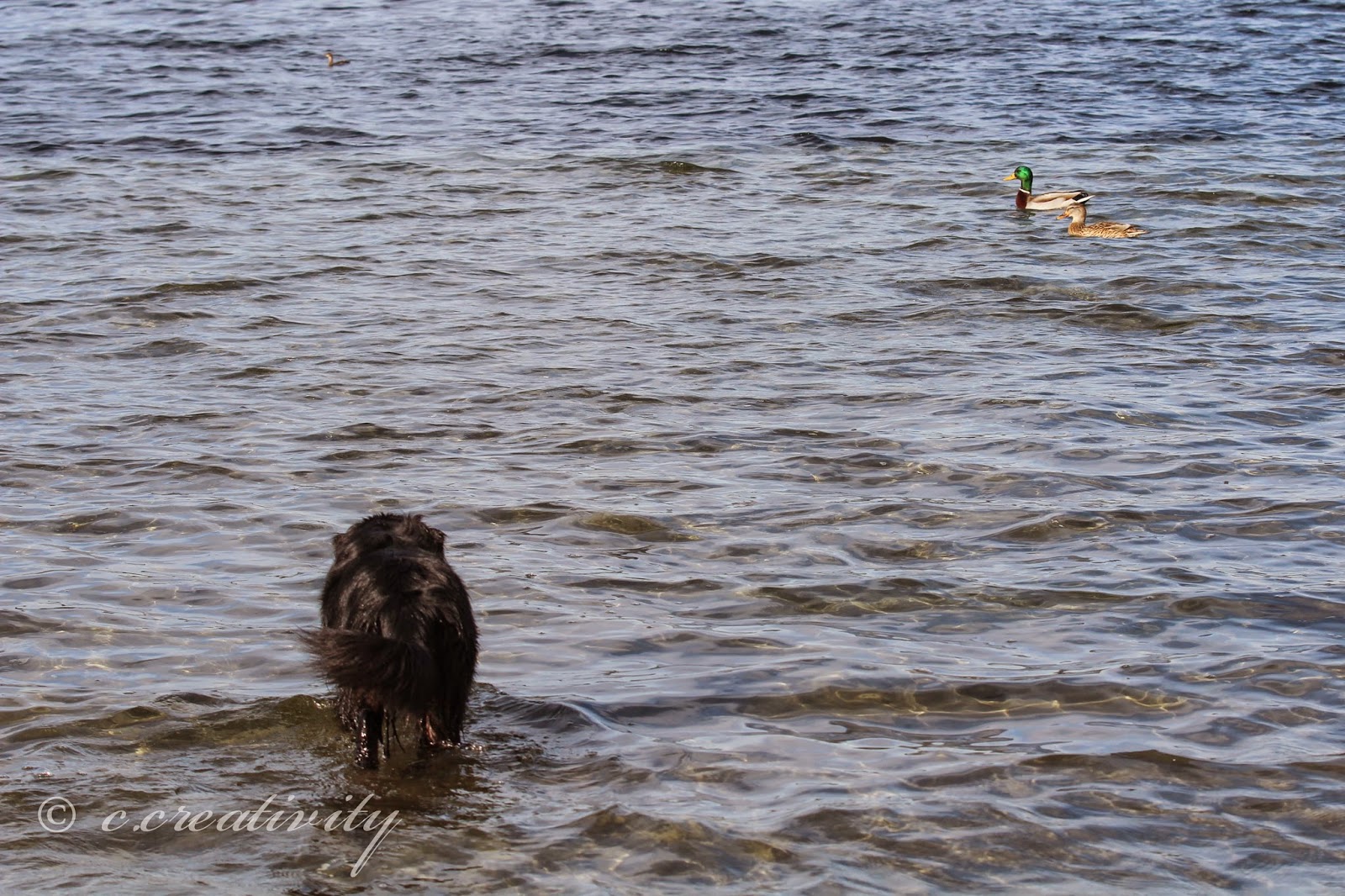
I don't know what this male mallard was thinking. He and a female partner landed on the lake nearby and while the lady duck swam AWAY from where I stood on the beach with two dogs playing in the water, this guy swam straight toward us. Evidently, he had much more experience with people handing out food than with dogs frisking in water. When he grew close enough, they gleefully gave chase.

The male mallard flies to safety after attracting the attention of the dogs.

Sable watches the male and female mallards as they swim by, this time at a safe distance.

A flock of mallards swimming and talking among themselves at sundown.

7. Gadwall

I was very pleased to have an opportunity to photograph gadwalls because they were one of the species that I saw at Mr. Gorgeous' but was unable to photograph because they'd come in at dusk to sleep on the ponds. Here, I saw more gadwalls than mallards! The females of the species look very similar, but the males are somberly attired in shades of brown and gray. They were often found in the company of Canada geese.

Two male gadwalls and a female forage for food just below the surface of the lake.

A female gadwall flaps her wings, revealing the black and white speculum, as a male gadwall and a Canada goose swim nearby. Mallards have a blue and white speculum--this detail can help you differentiate between female mallards and gadwalls when in flight.

Gadwalls on the wing.

8. Common Goldeneye

Goldeneyes were the diving ducks I saw most frequently at Mr. G's, but they were few and far between just a few miles to the north. The ones that did appear in the area preferred a patch of lakefront several houses away, hence the terrible first photo. I did catch a nice one of a goldeneye in flight, though!

Goldeneyes seen--just barely--at a distance.

A handsome common goldeneye in flight.

9. Bufflehead

I saw buffleheads every day, the females vastly outnumbering the males. (Where do all the males without harems go?) They often congregated in the water near the dock, but had the regrettable (from my perspective) habit of drifting away whenever I approached. The best way to get a good bufflehead photo (or photo of any of the water birds) was to sit on the dock and wait--they weren't keen on me looming tall over them. Fortunately, Goldie was happy to settle on the dock with me if I decided to lay low in hopes of photographing shyer varieties of waterfowl.

A pair of female buffleheads. They have a white oval facial patch.

They are rather sweet-looking little ducks.

The males have a large white patch that wraps around the back of the head. In certain lights, the black feathers on the head reveal themselves to be iridescent!

A male bufflehead in flight on a monochromatic day.

A male bufflehead, followed by two females, takes to the wing.

A flock of buffleheads swims toward a group of Canada geese as a pair of pied-billed grebes approach from the right. The birds often came together like this.

10. Common Merganser

I saw a female common merganser from time to time in the evenings, usually in the company of buffleheads. The female merganser's rusty head, slight crest, and long, thin bill (used for catching fish) make for easy identification.

A female common merganser in profile at sundown. While the coloration of the female merganser is similar to that of female goldeneyes, the slimness of the bill is a dead giveaway for identification.

I saw one from time to time in the company of buffleheads in the evenings.

A female common merganser with buffleheads.
  
11. Sharp-Shinned Hawk/Cooper's Hawk

It is notoriously difficult to tell these two species apart. There are very minor coloration differences, one has a smaller head in relation to its body, but really, the only thing that "easily" separates the sharp-shinned hawk and the Cooper's hawk is size. If you don't have a way of determining the size of the bird relative to an object, you're likely to be stuck with an "either/or" ID. These terrible photos I hastily nabbed when the bird landed in a tall tree almost directly overhead and then took off moments later can't provide information other than this is, indeed, in accipiter (versus a type of falcon such as a merlin--you can tell by the wings). One of my first thoughts when it landed was, "That's the size of a pigeon and the color of a pigeon, but it's a bird of prey!" As it so happens, sharp-shinned hawks are the size of pigeons. Cooper's hawks are several inches larger. So my tentative ID is that it was a sharp-shinned hawk.

An accipiter in the treetops.

There's simply no way you can make an ID between a sharp-shinned and a Cooper's hawk from a lousy photo like this one!

Falcons have pointed wings, so at least this photo was able to guide me toward the right hawk family.

12. Red-Tailed Hawk

I've been wanting to photograph red-tailed hawks for some time now because I see them all them time. The trouble is, I see them all the time sitting on light posts or trees next to the freeway, which is hardly the ideal way to photograph a bird. I was pleased, then, to be alerted to the presence of a pair of raptors by the calls of the crows, and to get a few pictures as they rose up and up into the sky. The bird book helped me determine that these were "dark phase" red-tailed hawks: that is, their bodies are dark on the underside instead of light. (These photos should definitely be clicked on to see in an enlarged format.)

Red-tailed hawk, dark phase.

A pair of them rose, circling, on a thermal.

13. Great Blue Heron

No herons came fishing at Goldie's place, but these massive birds did flap by from time to time.

A great blue heron silhouetted against a muted sunset sky.

Among the local birds, only bald eagles can beat the heron's 70" wingspan.

Great blue heron profile in flight.

14. Herring Gull

This is one of those photos I took for a simple ID before I'd resolved to make a blogpost out of the photos I'd been taking. I thought, "That gull looks different from the usual sea gulls I see out by the buoy," and yes, it's a herring gull rather than the usual ring-billed gull, but it's not much of a photo in terms of things to look at.

Herring gull.

15. Ring-Billed Gull

Ring-billed gulls are trim and elegant with a black ring near the tip of their bills. They were the gulls I saw most frequently. There was usually one to be had perched on the buoy some distance out from the dock.

You can see the tell-tale ring on the gull's beak in this photo.

One ring-billed gull vacates the coveted buoy as another comes in for a landing.

A ring-billed gull gliding across the sky.

For poetic purposes: a bird made of light and shadow standing out against a storm.

16. Anna's Hummingbird

Anna's hummingbirds zoomed hither and thither around Goldie's yard. This time of year, their primary interest was in the flowers of the bush ivy climbing one of the trees and cropping up in the thicket.

A pair of hummingbirds pause momentarily on adjacent perches. I've never seen two hummers share such close quarters without quarreling!

An Anna's hummingbird hovers as it investigates bush ivy buds.

17. Belted Kingfisher

It was the final afternoon of my two weeks with Goldie when I decided to walk down to the lake in the rain with the dogs, bringing my camera under my coat. I'm glad I did, because that's when I spotted a kingfisher flashing across the shore and swooping up to perch on the lines of a boat moored at a neighboring dock. I've found kingfishers to be elusive critters, so I was so pleased to see one and get a photograph, distant though it may be, of one of my favorite birds--and on my last day, no less! I hope that one day I'll have an opportunity to photograph one at closer range.

A female belted kingfisher shows off the marks that give the species its name.

The crest on the head can be raised or lowered, as it is here.

18. Red-Shafted Northern Flicker

I hadn't bothered to photograph any of the flickers I regularly saw and heard because the cedars and big leaf maple trees made it difficult to get clear shots and I can get much better photos at my house. Then, of course, I decided I was doing this blogpost and suddenly I needed a flicker photo, any flicker photo, but while I continued to hear them and see them flashing from place to place, the best I could do in terms of photographs was a silhouette.

Yep. that's a flicker up there.

19. Steller's Jay

I saw plenty of Steller's jays screeching raucously as they swooped from maple to maple and cedar to cedar. Because they moved quickly and nimbly among the branches of the overlapping trees, I didn't often have clear shots of these busy, noisy birds, but in the few good snaps I did get, the blue plumage looks particularly beautiful.

A Steller's jay takes a quick break from bouncing from branch to branch and offering its strident commentary to absorb some sunlight.

Blue sky, a blue tail, and a crested silhouette.

20. American Crow

Crows are ubiquitous everywhere, so there naturally were crows to be found around Goldie's house where they flapped and cawed and occasionally flew low and slow over the lawn to take a closer look at what the dogs and I were doing. What was remarkable was that I discovered, while sitting on the dock at dusk one evening, that I was directly below an established flightpath for thousands of crows flying north to their winter roosting grounds at the top of the lake. I've seen the masses of crows seeking out their nighttime perches in the cottonwoods there at sundown, so I knew where the birds were headed and why, but it was still an amazing sight to see this ribbon of crows unfurling across the sky, crossing the lake and then heading north along its shore and directly over the dock. Group after group of crows, with roughly fifty (probably related) crows per group, passed overhead; at one point, this stream of crows stretched north as far as the eye could see in one direction and southwest in the other with more coming into view. I like crows, so I thought it was really amazing to see so many flying home to roost in such an orderly fashion!

A crow passes low overhead, curious about the antics of the dogs.

Crows for miles.

It brings to mind one of my favorite lines from Shakespeare:
"Light thickens, and the crow/ Makes wing to th' rooky wood"

21. Black-Capped Chickadee

I was interested to see that while there were plenty of black-capped chickadees hopping about and giving their signature calls, I didn't see a single chestnut-backed chickadee. I saw both species at Mr. Gorgeous' house and at my own, chestnut-backed chickadees outnumber the black-capped ones. Chestnut-backed chickadees particularly like conifers, so perhaps they stayed within the bounds of the vast, forested park just to the north, leaving the mix of maples, cedars, brambles, and open spaces to their black-capped brethren?

A black-capped chickadee with a seed in its bill.

Chickadees ARE very endearing little birds.

22. Bushtit

While there was abundant small bird life to be had, bushtits appeared but rarely. These minute birds usually travel in large flocks fluttering and twittering in high voices as they comb through trees for insect prey. The drab coloring, long tail, and tiny black bill can be used to separate it from other small, grayish birds of similar habits.

A bushtit clings to the tip of a leaf as it hunts for the tiny insects that make up its diet.

23. Bewick's Wren

I always consider it a big score to get a good photo of a Bewick's wren because these chatty little birds never stop moving and seldom break cover! They loosely associated themselves with the local small bird flock, but I would see them on their own from time to time, too. I was able to get the photos below because I realized there was a Bewick's wren in the shrub just above me as I was walking down a slope that was systematically working its way through the tangle of stems and branches in my direction. I waited quietly with my lens pointed at where I expected it to come into view and then *snapsnapsnapsnap* took a few hasty photos before it flitted off into the depths of another bush.

Bewick's wrens are small, busy brown birds with bold white eyebrows and long, cocked tails that they flick as they forage.

Oh, how I wish this photo was more perfectly focused! But with this fast-moving bird, I was lucky to get even this.

24. American Robin

Robins are at home in virtually any kind of habitat, so it was no surprise to find them in this wild, woodsy margin of the suburbs.

A female robin, puffed up picturesquely against the cold, warms herself in the morning sunlight on a branch adjacent to a holly bush.

A pair of robins (there's one perched more discretely to the lower right) alight on a tree's bare branches in the wan, late-autumn light.

25. Ruby-Crowned Kinglet

Kinglets are truly tiny birds and I saw them mixed in with the small bird flock, though not in great numbers. Franticly-moving tree foragers like the bushtits, they can be distinguished by their grayish-olive color, shorter tail, black and white wing bar, and white eye ring. The ruby crown that gives the species its name is only seen when males chose to raise it--which is seldom.

The kinglets largely confined themselves to the green, sheltering depths of the massive cedar trees.

26. Cedar Waxwing

I was extremely pleased to spy a cedar waxing feasting on some late blackberries one day. While hardly a rare bird, I seldom see them and have only had one other occasion to photograph them and that was at a distance. Handsome, crested birds with a black eye mask and waxy red appendages on the tips of some of their wing feathers, these fruit-eaters are a delight to the eye.

A cedar waxing, with red waxy tips just visible on the wing's secondary feathers, gives me the once-over.

The waxwing digs into a blackberry feast.

A beautiful cedar waxwing on a beautiful fall day.

27. Townsend's Warbler

I saw Townsend's warblers on several occasions, usually feeding in small groups in the massive Western redcedars, swiftly hopping and flitting from branch to branch in search of insects. It was relatively easy to spot their yellow faces marked by the dark eyepatch (if you were scanning the trees for birds, at least), but hard to get good photos.

A female Townsend's warbler.

Townsend's warblers have streaked, yellowish-olive backs and two white wingbars.

That little flash of yellow face alerts you to the presence of the Townsend warbler in this tree.

This photo, however, better suggests the scale that I was dealing with to get the photographs.
Can you spot the Townsend's warbler in this one? 

28. House Finch

House finches were the predominate species in the small bird flock around Goldie's house. Cheeping to one another, they'd swoop between the trees, congregate in the thickets, and hop around on the ground near the back door as they searched for seeds.

A male house finch with a winged seed pod in its beak.

A male house finch with several female house finches.

A male house finch perching on blackberry brambles as extracts the seeds from the desiccated fruit. My normal policy is not to take photos through windows unless I absolutely have to, but since the finches favored a thicket of shrubs and vines along the side of the house visible only though the windows, I overcame this prejudice and got some good photos. This one happens to be one of my favorites out of all the bird photos I took during this gig!

A female house finch regards me from the gutter.

A male house finch with hardly any red pigmentation fluffs himself up against the cold in the company of other finches.

This male was the reddest of the bunch. The pigment comes from the food they eat. Females prefer the reddest males, likely because it signals that the bird can gather lots and lots of food, thus making a good provider for nestlings.

29. Pine Siskin

This was a species that was new to me and I'm always pleased to add to my list! I stood under this tree for the longest time looking at the birds in it. Some of them were most definitely house finches--I could see the red on the males--but there were these other streaky-breasted birds about the same size that looked like female house finches--and some of them were female house finches--but now and then I'd see wing bars and a flash of...yellow? It was when the whole flock left the tree and I captured them in flight that I saw the yellow stripe on the unfurled wings that ultimately led me to their identification.

With their streaky breasts, overall brown coloring, and similar size, pine siskins bear a strong resemblance to female house finches.


It was the bold wingbars and traces of yellow, like those seen on the bird with its back to the camera, that made me suspect I was looking at a different species.

The pine siskins traveled in a large flock. This tree is full of them!

When the flock left the tree, I was able to capture the yellow stripe on the underside of the unfurled wings. Click to enlarge to better see what I'm referring to.

I've included this photo not just because it clearly shows the yellow on the wings of the bird near the top, but because all but three of the birds in the flock have folded their wings as they dive together like little missiles through the sky!

30. Rufus-Sided/Spotted Towhee

At my house, the towhees keep largely to themselves, so I was interested to see that they flocked with the small birds--namely finches, juncos, and song sparrows--at Goldie's, a different composition than the wintertime small bird flocks I see at home. I really like towhees and wish I could have gotten better photos, but my best chances for photographing the small bird flock usually came through the windows and shots through windows are never as crisp and clean. *Note: It has come to my attention that since the publication of the edition of the field guide I use for bird identification that the rufous-sided towhee, with its western and eastern races, has been split into two species: the spotted towhee (formerly the western race of the rufous-sided towhee) and eastern towhee. Because I strive for accuracy, I will attempt to shift my usage over to the current one.

These large sparrows are beautifully and boldly patterned birds.

The quality of this photograph is poor, but I loved how the light set the rufous eye of the towhee ablaze! 

31. Oregon Junco

I suppose if I'm striving for accuracy, I should label this bird as a "dark-eyed junco (Oregon race)". However, since there are fifteen described races, merely identifying this bird as a dark-eyed junco could create confusion among those, say, who only know the white-winged race or gray-headed Rocky Mountain race. The Oregon junco is widespread across the western US and therefore should be recognizable by that name to many birders. I have abundant opportunities to photograph these charming little birds in much closer quarters in my own yard, so only took this picture for the purposes of this blogpost.

A male Oregon junco.

32. Song Sparrow

Speaking of birds with regionally variable plumage... There are twenty-four subspecies of song sparrows with different variations on the theme of brown and gray and the denizens of the Pacific Northwest are among the darkest, brownest, and streakiest!

A song sparrow pauses momentarily on a rock before hopping off to forage for seeds, fruits, and insects.
33. Trumpeter Swan

The trumpeter swan is the one species that I saw while dog-sitting Goldie that I was unable to photograph. I was standing in the lane overarched by towering big leaf maples when I heard a flock of birds with honking calls winging my way. They were different than the calls of the Canada geese and I was wracking my brain for any other goose species that might be flying around in the region when a flock of swans, gleaming white against the blue autumn sky, flew into view. It was an astonishing and majestic sight, but there was no possibility for a shot as they swiftly passed through the patches of sky visible through the tree branches and then were gone. I was so sorry not to get a photo of the swans that after the dog-sitting gig was over, I drove to the park about four miles from Goldie's house where trumpeter swans winter and photographed them there. These may very well be the same swans I saw flying over, as I am unaware of other populations wintering on the lake. 

Trumpeter swans doze and preen in their usual wintering spot, a shallow and protected bay.

That sums up "33 Birds: November Edition," demonstrating the variety of birdlife that can be found on wooded, lakeshore suburban property in this particular corner of the Pacific Northwest during a two-week survey in the month of November. As usual, Golden's "A Guide to the Field Identification: Birds of North America" was an indispensable tool, as was the excellent website All About Birds, and Google images proved very useful for verifying ID's, especially for birds in eclipse plumage or in positions not shown in the various guides. While not everyone has access to lakefront property, if you start paying attention, you may find that you're surrounded by far greater numbers and varieties of birds than you might expect. Happy birding!

To see the follow-up to this post, click here!

Previous bird posts include:

Also, be sure to stop by my Facebook page, where I frequently post bird photos!